
St Anthony of Padua Catholic Church

Beeston · Leeds
Visit St Anthony of Padua
19 Old Lane, BeestonLeeds, LS11 7AA
Part of St Maximilian Kolbe Parish. You are welcome to join us for Mass and prayer.
The History of St Anthony of Padua, Beeston
More than 120 years at the heart of the Beeston Catholic community
For more than 120 years, St Anthony of Padua Catholic Church has been a familiar and much-loved part of Beeston. Situated on Old Lane, the church has witnessed enormous changes in the area around it, yet throughout all those changes it has continued to provide a place where generations of local people have come together to worship, celebrate the sacraments and support one another.
Today, St Anthony’s is part of the Parish of St Maximilian Kolbe, alongside St Francis of Assisi in Holbeck. The parish we know today is very different from the one that existed when the church first opened its doors in 1905, but many of the traditions and values established by those early parishioners remain at the heart of parish life.
The history of St Anthony’s is therefore not simply the history of an old church building. It is the story of the people who built it, worshipped in it, cared for it and passed it on to the generations that followed.
The beginnings of a Catholic community in Beeston
At the beginning of the twentieth century, Beeston was changing rapidly. The growth of industry in Leeds had brought large numbers of people into the surrounding districts, and new streets of housing were appearing to accommodate the growing population.
Among those moving into the area were many Catholic families, and the Catholic population of south Leeds was steadily increasing. At this time, Catholics living in Beeston were served by neighbouring parishes, particularly St Francis of Assisi in Holbeck.
As the number of Catholic families increased, however, the need for a church closer to home became increasingly apparent.
In 1903, Father McAuliffe of St Francis of Assisi acquired land on Old Lane, Beeston, with the intention of building a new Catholic church. It was an ambitious undertaking for a growing community, but the plans soon began to take shape.
On 6 November 1904, the foundation stone was laid by Canon Croskell of St Anne’s Cathedral, marking the formal beginning of the construction of the new church.
The architect was Charles Edward Fox of Dewsbury, who was responsible for a number of Catholic churches within the Diocese of Leeds. For St Anthony’s he produced a design in the Decorated Gothic tradition, using red brick with stone detailing to create a substantial and distinctive building.
The opening of St Anthony’s
Construction was completed surprisingly quickly, and the new church was opened in 1905, with Bishop Gordon carrying out the formal opening.
For the Catholics of Beeston, this was an important moment. A permanent church had been established in the centre of their own community, providing somewhere for families to attend Mass without having to travel to neighbouring districts.
The new church was dedicated to St Anthony of Padua, whose statue was placed above the main entrance. St Anthony remains the patron of the church to this day.
Just four years later, in 1909, St Anthony’s became an independent parish. This was another significant stage in its development and reflected the growing importance of the Catholic community in Beeston.
From that point onwards, the parish developed its own identity and its own traditions, with the church becoming an important part of everyday life for Catholic families in the area.
A church at the centre of family life
For many people who have grown up in Beeston, memories of St Anthony’s are inseparable from memories of family and childhood.
Over the years, generations of local families have brought their children to the church for Baptism, First Holy Communion and Confirmation. Couples have married there, families have gathered for funerals and countless parishioners have attended Sunday Mass and weekday services.
The church has also been closely connected with the education of Catholic children through St Anthony’s School, creating a strong link between the parish and the local Catholic school community.
The contribution made by individual parishioners can also be seen in the fabric of the church itself. One particularly interesting example comes from the Moorhouse family, whose history records that members of the family attended St Anthony’s School and worshipped at the church. In 1934, members of the family provided the marble altar and altar rails in memory of members of their family.
It is examples such as this which give an insight into the way parish churches were built and maintained. The history of St Anthony’s was not simply created by priests and the Diocese; it was also shaped by the generosity and commitment of ordinary families who regarded the church as their own and wanted to leave something behind for future generations.
The church building
The architecture of St Anthony’s remains one of the most visible reminders of its origins.
The church has a six-bay nave with aisles, Gothic arches, octagonal columns and a timber roof. The original design gives the building a strong sense of proportion, while the red brick and stonework give it the distinctive appearance that has made it such a familiar landmark in Beeston.
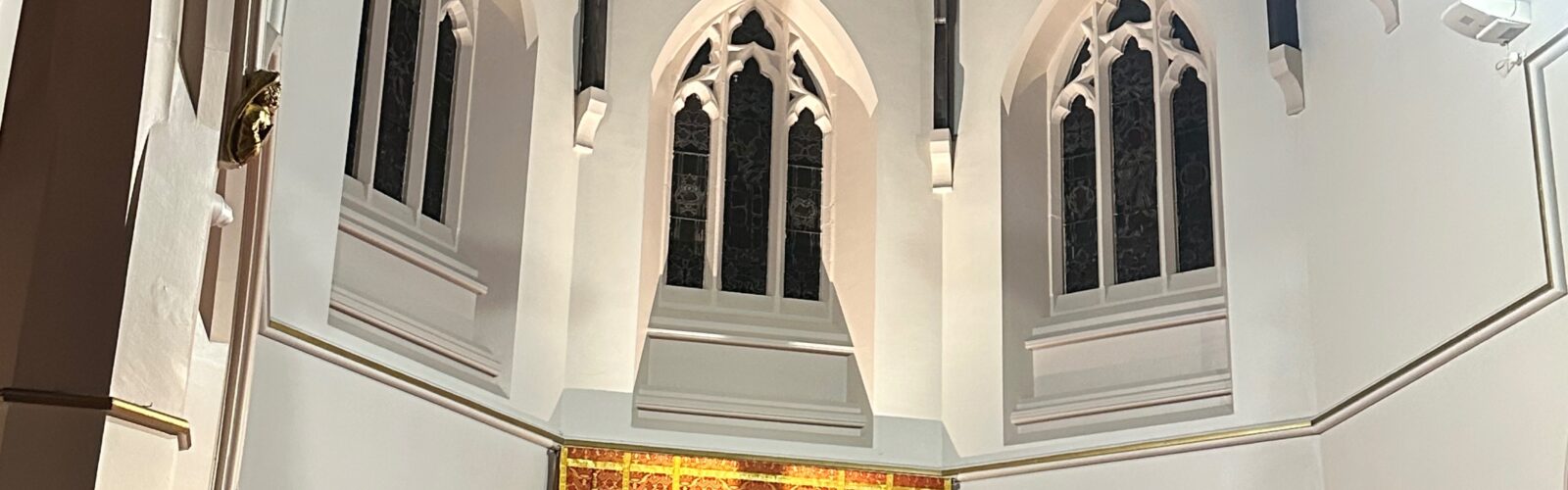
Inside, the sanctuary contains stained glass depicting St Anthony surrounded by angels, while side chapels are dedicated to Our Lady and the Sacred Heart.
There are also a number of surviving historic features within the church, including elements of the original oak pulpit, which was decorated with carved scenes from the New Testament.
The marble altar dates from 1934, when the church was formally consecrated.
Consecration in 1934
Almost thirty years after the church opened, St Anthony’s reached another important milestone.
In 1934, the church was formally consecrated by Bishop Cowgill.
By this time the parish was well established and the church had become an important part of life in Beeston. The installation of the marble altar and altar rails that year, funded through the generosity of parishioners, was another indication of the pride that local people took in their church.
For those attending St Anthony’s during the 1930s, the building would already have been an established landmark and a familiar part of everyday life. Few could have imagined that it would still be serving the local Catholic community more than ninety years later.
The addition of the tower
One of the most noticeable changes to the church came more than thirty years later.
In 1966, a new bell tower was added to the south-west corner of the building. Designed by architect George Adkin, the tower was deliberately different from the original church, using contrasting brown brick together with a copper-covered pyramidal roof and distinctive glazed panels.
The addition gave St Anthony’s a new architectural feature while allowing the original Gothic building to remain largely unchanged.
At the same time, the area beneath the western gallery was enclosed to create a narthex, providing a more practical entrance and gathering area.
The tower is an interesting part of the church’s history because it reflects the changing architectural tastes of the period. St Anthony’s had begun life as a traditional early twentieth-century Gothic church, but by the 1960s the parish was willing to introduce more modern ideas while retaining the historic building.
Changes to the sanctuary
The 1960s and 1970s were years of considerable change throughout the Catholic Church, particularly following the Second Vatican Council.
As the celebration of Mass changed, many churches were required to adapt their sanctuaries so that the priest could celebrate Mass facing the congregation.
St Anthony’s underwent its own changes as part of this development. In 1984, the sanctuary was reordered and the original marble altar was adapted, with the altar mensa being brought forward.
These changes form another part of the story of the building and demonstrate the way in which St Anthony’s has adapted to changes in Catholic worship while retaining many of its historic features.
One hundred years of St Anthony’s
In 2005, the parish reached a remarkable milestone when St Anthony’s celebrated its centenary.
A hundred years had passed since the church first opened its doors, and the anniversary provided an opportunity to look back at the generations of people who had contributed to parish life.
During those hundred years, countless priests had served the parish, while generations of parishioners had volunteered their time, supported fundraising, served at Mass, taught children, organised parish activities and helped to maintain the church.
For many families, the centenary was also a chance to remember relatives who had been part of St Anthony’s during earlier decades. The names and faces may have changed, but the connection between the church and the local community remained remarkably strong.
The historic organ
Music has also formed an important part of worship at St Anthony’s, and the church now has a particularly interesting connection with Britain’s organ-building heritage.
In 2020, a historic pipe organ was installed in the western gallery. The instrument was originally built in 1893 by Forster and Andrews of Hull, one of the most respected organ-building firms of the Victorian period.
The organ had originally been installed in a church in Borthwick, Scotland, before eventually finding a new home at St Anthony’s.
David Wood of Huddersfield undertook the installation, replacing the church’s previous electronic instrument. The painted and gilded pipes are particularly attractive within the gallery and complement the historic character of the building.
An inaugural recital was held in August 2020, giving the instrument a new lease of life and ensuring that a piece of Victorian musical history could continue to be heard in the church.
St Anthony’s and the Parish of St Maximilian Kolbe
The Catholic community of Beeston has changed considerably since the church opened in 1905, as has the structure of parish life across the Diocese of Leeds.
St Anthony of Padua is now part of the Parish of St Maximilian Kolbe, together with St Francis of Assisi. The two churches share in the life and mission of the wider parish while continuing to provide places where local communities can gather for Mass, prayer and the celebration of the sacraments.
The Feast of St Anthony of Padua on 13th June remains a particularly significant occasion, with parishioners and the school community coming together to celebrate the church’s patron saint.
Although the parish structure may have changed over the years, the purpose of the church remains much the same as it was when the foundation stone was laid in 1904.
A living part of Beeston’s history
When we look at St Anthony’s today, it is easy to concentrate on the age of the building and its architectural features, but the most important part of its history cannot be found in the bricks, stone or stained glass. It is found in the generations of people who have made the church part of their lives.
Since 1905, thousands of local people have walked through the doors of St Anthony’s, often at the most significant moments of their lives. Children have been baptised here and have returned years later for their First Holy Communion and Confirmation; couples have stood before the altar to begin married life together; families have gathered to celebrate and, at other times, to mourn the loss of those they love. For many people, their memories of the church will also include serving at Mass, singing in the choir, attending the school, taking part in parish organisations, helping with fundraising or simply meeting friends and neighbours after Mass on a Sunday morning.
The building itself tells much of this story. The foundation stone laid in 1904, the original Gothic architecture, the marble altar installed in 1934, the tower added in 1966 and the historic organ installed in 2020 all belong to different periods in the life of the church, yet together they form a record of how the parish has grown and changed. Each generation has inherited what was left to them by those who came before, made its own contribution and then passed the church on to the next generation.
That is perhaps what makes St Anthony’s such an important part of Beeston. It is not simply an old church which has survived for more than a century; it is a place that has continued to be used for the purpose for which it was built. The people who worship there today are part of the same continuing story as those who gathered for Mass when the church first opened in 1905, even though the streets around them, the parish itself and the wider world have changed enormously.
As part of the Parish of St Maximilian Kolbe, St Anthony’s now looks towards the future while carrying with it the memories and traditions of more than 120 years of Catholic life in Beeston. The responsibility for caring for the church and maintaining its place within the community now belongs to the present generation, just as previous generations took responsibility for it in their own time.
The story of St Anthony of Padua is therefore not simply something that belongs in the past. It is a history that is still being written every time the church doors open, every time Mass is celebrated, every time a child is welcomed into the Church, every time a family gathers for a wedding or funeral, and every time parishioners come together in prayer and fellowship.
More than 120 years after that first foundation stone was laid, St Anthony’s remains a place of faith, worship and community in Beeston, continuing a tradition that began at the start of the twentieth century and which, through the people who worship and serve here today, will hopefully continue for generations to come.